
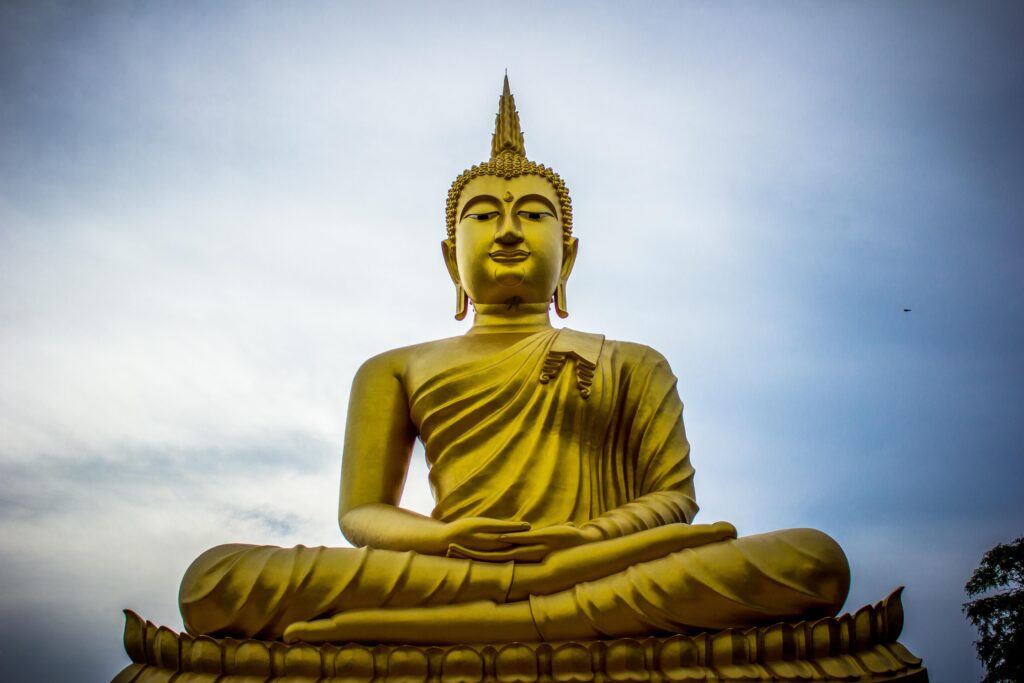
When Westerners think about the Buddha, we often fall into the trap of thinking that the Buddha is God. This makes sense for us considering there are Buddhist shrines, the religion is called Buddhism, and through our association with Jesus being considered God, it is natural that we would fall into this line of “God” thinking. That’s why it’s important to clear up this misconception. The Buddha (properly known as Śākyamuni Buddha) was simply a man who transcended cyclic existence. He was actually a prince named Siddhārtha Gautama, born in approximately the 5th century BCE most likely around the India-Nepal border.
As a prince, Siddhārtha Gautama was kind-hearted, intelligent, very sheltered, and never really left the palace. At one point he does leave the palace and he sees real suffering in town with his own eyes. He sees a sick person, an old person, and a dead body, which truly shakes him. This causes him to very seriously contemplate suffering, which in turn leaves him wanting to leave the pleasures of palace-life, and leaves him wanting to be free from what he perceives as an endless cycle of suffering. He decides to leave his family, his royal position, his fancy clothes, and becomes a wandering mendicant at the age of 29. Though he masters the best meditation techniques of the time, he knows he has not found the freedom he is looking for.
Siddhārtha Gautama goes on to avoid all forms of indulgence, and in so doing neglects his body. His body becomes very thin and overall his health declines. He eventually realizes that bodily torture does nothing to calm the mind, and that there must be a better way towards his goal. He then develops a moderate approach, “the middle path,” which requires taking care of the body without indulging in sensual pleasure. In a story that many people know, he sits under a bodhi tree in India and refuses to get up until he attains full awakening. He succeeds on what is now the Buddhist holiday of Vesak, leaving his mind officially cleared with no mental obscurations and with only good qualities in their wake. This essentially means that all of his afflictive emotions, such as anger, hatred, and jealousy, have been transformed into purely good qualities like love, empathy, and generosity. He has now, at 35 years old, become a buddha, or a “fully awakened one.”
Over the next 45 years he teaches his experience to whoever wants to hear, and these people included high-society members, the lowly, and everyone of every race in between. His teachings were adjusted and geared towards what each individual was facing at the moment. This means that he taught different things to different people, depending on where they were on their spiritual journeys. This is something that makes sense but is sometimes lacking when people don’t have a proper spiritual teacher. Broad, slightly impersonal teachings can leave some people confused and disheartened, but understanding each human being’s unique needs, and adjusting their teachings accordingly, ensures that everyone can be reached and can develop further along their unique spiritual paths. Someone bathing in money and fame, for example, would need a different approach on how to reach enlightenment than someone who is starving and living on the streets. That’s just logical.
Precisely that seems to be one of the lures to Buddhism – its inherent drive towards logic, not blind faith. The Buddha speaks of ehipaśyika, or “come and see.” This essentially means not to blindly believe what you are told, but to put those teachings into practice in your life and only then believe them. Unless we practice what we believe, our beliefs are rather empty and have no foundation. The Buddha was a human who figured out the answers to the big questions, and his teachings are still very much valid, beautiful, and needed today.
But wait, that’s not the end of the story. That’s simply one Buddhist understanding of the Buddha’s life. Another perspective would be to view the Buddha’s life through the doctrine of the four Buddha bodies. The four Buddha bodies are better understood as four qualities, or even four layers. They are a bit confusing at first, but they’re easier to grasp (in my opinion) when viewed in the reverse. The four bodies are:
The emanation body, which is the Buddha’s physical appearance as a normal person. The Buddha (and other buddhas) assume a physical body based on the spiritual needs and spiritual states of the disciples at that time.
The enjoyment body is what the emanation body manifests from. This is the form a buddha assumes to teach bodhisattvas in what is known as the pure land.
The Wisdom Truth Body is what the enjoyment body manifests from. This is the all knowing mind of the Buddha.
The Nature Truth Body is what the wisdom truth body manifests from. This is the ultimate truth.
The Dalai Lama tells us to view this in the reverse to really understand it. If you look at the big picture, the Buddha realized the ultimate truth (Nature Truth Body) and the truth about all conventional phenomena (Wisdom Truth Body). So the Buddha knew literally everything. Out of compassion came a subtler form (Enjoyment Body) which could guide great bodhisattvas. So out of compassion, this all-knowing mind of the Buddha transformed into this more accessible Enjoyment Body in order to teach its wisdom to the great bodhisattvas. As a side note, a bodhisattva is someone who is able to reach nirvana, but delays the process in order to help other suffering sentient beings. Then, in order to help normal folk like us, whose minds are all much more obscured than the minds of the bodhisattvas, an even more accessible Emanation Body manifests from the Enjoyment Body. So in other words, this Enjoyment Body transforms further into the Emanation Body, which looks like a normal human body, in an effort to aid humanity in whatever body-form we need in our particular time and place. This entire process begins with an all knowing state that, in a beautiful process, produces the Buddha in human form for the benefit of humanity. This is what allowed people to see the Buddha’s Emanation Body, which looked like a normal body, and this is what allowed him to interact with people and give humanity the teachings we have today. So to sum up, from these higher, all knowing bodies, and combined with compassion for all sentient beings, came forth these lower bodies, which were able to interact with, and teach, different sentient beings the way towards the ultimate truth.
The great thing about this viewpoint is that it means that the Buddha did not cease to exist after his death, as the other theory tends to posit. By playing the tape backwards, we can see that the Buddha’s human body came from his enlightened mind, so after his death, it makes sense that the continuity of his mind would not cease to exist, given that the mind produced the body. This also means that if we could reach a certain level in our own spiritual journeys, we could have the chance to speak with him. The farther along the path we travel, the more we will be able to perceive things that are imperceptible now, in the same way, as the Dalai Lama points out, that microscopic organisms were invisible before the invention of the microscope.
We also don’t need to pick a “team” to be on, as far as these two theories go. Sometimes it’s helpful to look at the Buddha as a perfectly normal human being, whose example we can use as a guide for our own morals and conduct. Perhaps it’s more comforting at other times to look at the Buddha on this more grand scale, and to know that he is not gone, and that we are always being cared for. Whatever way you decide to view it all, as long as it’s done using reason, respect, and respect for the other viewpoint, you chose right.
SOURCE:
Approaching the Buddhist Path: The Dalai Lama and Thubten Chodron
Leave a Reply