
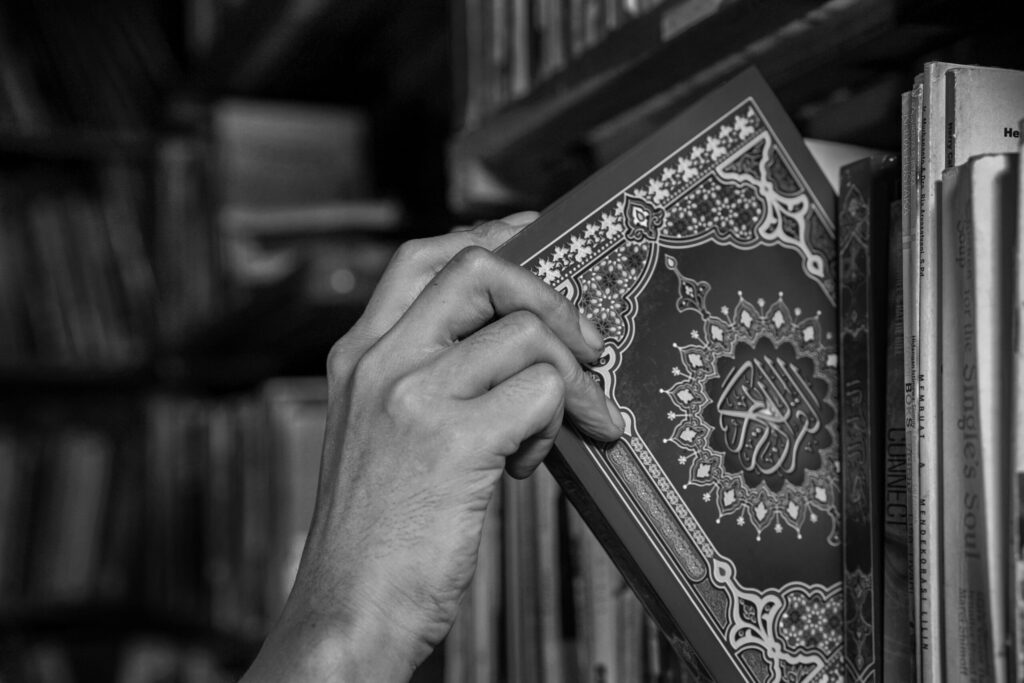
- Islam is an Abrahamic religion. This means that like Judaism and Christianity, Islam is one of the great monotheistic faiths, which traces its ancestral roots back to Abraham. While Jews and Christians trace their ancestry back to Abraham, Sarah, and their son Isaac, Muslims are descendants of Abraham, Hagar, and Ishmael. For those who are unfamiliar with this story, Abraham and Sarah are told that they will have a child together despite their very old age. A while goes by and Sarah is still not pregnant, so it is decided that Sarah’s handmaid Hagar should be the one to carry the child. Hagar becomes pregnant with Abraham’s child and an angel of the Lord tells her that he will increase her descendants so much that they will be too numerous to count. Later on Sarah ends up pregnant herself, and fearing that Ishmael, the firstborn, would share the inheritance with Isaac, she tells Abraham to send his firstborn son and Hagar, his mother, away. Ishmael almost dies of thirst on the journey but God hears his cries and produces a well of water for them. He tells Hagar that he will make a great nation out of Ishmael and God is with Ishmael as he grows up. Considering there are almost 2 billion Muslims, I’d say the promise of a great nation was fulfilled with gusto. (This story can be found in the Bible scattered through Genesis chapters 16-21) The Muslim tradition has the story a touch different, Abraham takes Hagar and Ishmael near the Ka’ba and drops them off trusting them to God. After the mother and son grow ever more thirsty and Hagar can find no one in sight to help them, an angel of the Lord dug up the earth until water flowed. Whichever version of this story you read, it’s clear that God is with Ishmael and Hagar.
- Only about 20% of Muslims live in the Middle East. In the west we tend to think of Islam as a purely Middle-Eastern religion, but it’s worth noting that although Islam began in the Middle East, the majority of Muslims live in Asia and Africa.
- Muhammad did not want to be a prophet. Let’s start off by clarifying a common misconception. Muhammad, unlike Jesus, is not considered to be God. Muhammad was simply a human prophet who was God’s instrument for revealing God’s revelations to the world. Muhammad was so morally pure and honest that he is often called the “living Quran” and he is also the ideal role model for all believers on how to live their own lives. This being said, Muhammad spent absolutely no time praying to become God’s messenger, instead in the year 610 he heard a voice commanding him to “recite”. He replied that he had nothing to recite but was asked two more times to “recite”. After a bit of bewilderment, he began to recite the first of many revelations given to him by God through the Angel Gabriel. These recitations would later become the Quran. After this initial episode, Muhammad was concerned that he was going crazy and had to seek the advice of his wife who assured him that he was, in fact, not crazy.
- Jesus is in the Quran. As we mentioned earlier, Muslims are descendants of Abraham and are part of the Abrahamic tradition. This being said, there is quite a bit of overlap between the Judeo-Christian religions and between Islam. For Muslims, Islam is the fulfillment of God’s earlier revelations to the Jewish and Christian prophets. This is a similar concept to Christianity considering Jesus to be the fulfillment of God’s revelations to the Jews. The Quran confirms that the Torah and Gospels are revelations from God, but the belief is that those revelations became corrupted over time. The Quran was sent as a correction to the human corruption of the word that God had previously brought down. This is why Abraham, Moses, Jesus, and Mary are all central figures in the Islamic scriptures.
- Jihad is not supposed to be aggressive. Muslims are called upon, both individually and as a community, to exert (jihad) themselves in order to realize God’s will. Muslims are supposed to live virtuously in order to fulfill Islam’s mission and spread. Jihad can also mean the defense of Islam, which is often called holy war. Jihad, however, is not supposed to include aggressive, offensive warfare but instead allows for defensive warfare.
Sources:
The Great Courses Series: Great World Religions – Islam Lectures 1-3
Leave a Reply